A Thought to Share
Until December 2022 called “Thought for the Month”

“I still have many things to say to you, but you cannot bear them now. When the Spirit of truth comes, he will guide you into all the truth; for he will not speak on his own, but will speak whatever he hears, and he will declare to you the things that are to come.” (John 16:12–13)
“You cannot bear them now…
When the Spirit comes…”
Lord you spoke these words
to your disciples
enfolded in their own grief
and puzzlement
In the midst of trauma
yours was the cautious voice
of waiting
the consoling voice
of promise
In your infinite compassion
you made space
urging them to do the same
In these times,
we, like the disciples
are anxious to know
and understand
and impatient
to act.
Calm our jets, Lord
Show us how to wait
Still our racing reactivity
Encourage us to care for ourselves
before we barge on
with fixing the world
or even the church.
Reassure us
that yours is a long term call
that warrants
patience
kindness
gentleness
humility
compassion
and love
for ourselves
and others.
Enable us
to sit contemplatively
with unanswered questions
to nurture
our grieving spirits
to make space for you
to pour in your healing
and your wisdom
in your time
when you consider
that we are able to bear it
And Lord
through the great cacophony
of voices
urging us this way and that
enable us to discern
your still, small voice
of clarity
and purpose.
So may it be.
Thanks to our good friend Liz Crumlish for suggesting that we re-post her blog as a word of encouragement for our sad times.

The Ascension of Jesus
So when they had come together, they asked him, “Lord, is this the time when you will restore the kingdom to Israel?” He replied, “It is not for you to know the times or periods that the Father has set by his own authority. But you will receive power when the Holy Spirit has come upon you; and you will be my witnesses in Jerusalem, in all Judea and Samaria, and to the ends of the earth.” When he had said this, as they were watching, he was lifted up, and a cloud took him out of their sight. While he was going and they were gazing up toward heaven, suddenly two men in white robes stood by them. They said, “Men of Galilee, why do you stand looking up toward heaven? This Jesus, who has been taken up from you into heaven, will come in the same way as you saw him go into heaven.” (Acts 1:6–11)
40 days since Easter
40 days since we applauded Jesus’ sacrifice
then hauled him out of the tomb
and got on with our lives
40 days that Jesus has walked beside us
offering us myriad glimpses
of his Risen presence
It was the Risen Christ who sat on the bridge
holding out his cup for a coin
and then took our hand
and looked into our eyes
and said thank you
as we glanced his way
and gave him some change.
It was the Risen Christ
who sat between us
as a colleague unloaded
and processed
the costliness of her work
and rediscovered her inner wisdom
and strength
to carry on serving.
It was the Risen Christ
who dried our tears
and stoked our anger
and determination
as we tramped the beach
imploring, beseeching God
to show us how
to serve authentically
in an institution
that is besieged
by power struggles
and injustice.
It was the Risen Christ…
It IS the Risen Christ
The Risen, Ascended Christ
who continues to penetrate
our consciousness
in our every day
looking into our eyes
through the eyes of all whom we encounter
reminding us of his teaching
imploring us to love
and willing us
to go and be disciples.

On Sunday at the St Margaret’s service the focus of the readings was the Good Shepherd, with Psalm 23 both read and sung and complementary readings from Revelation and John’s Gospel. The prayer of preparation suggested by dailyLectio.net had been:
God of comfort and compassion, through Jesus, your Son, you lead us to the water of life and the table of your bounty. May we who have received the tender love of our Good Shepherd be strengthened by your grace to care for your flock. Amen.
An important and often-overlooked way of caring for the flock was the subject of Deacon Lynda Wright’s talk about her work with the Mental Health Community Chaplaincy, and the importance of listening.
Nowadays, as fewer people have church or faith connections or friends who they trust to share with, it’s increasingly hard for them to know where to go when things are getting them down, or they’re struggling with loss or illness or the breakdown of a relationship, or life isn’t making sense for them. As Lynda continues in her blog:
… They go to the GP because they are hurting, but the GP often knows that the problem is not a physical one which they can treat, but an emotional one. So they refer to this Listening Service, where individuals are enabled to explore the kind of issues named above.
People do need to talk. It is not uncommon for an individual to say at the end of the session, ‘Thank you so much, that has been so helpful’, when the Listener feels they have done very little – just listened! Of course, they have created a welcoming, non-judgmental, safe space, where the individual felt safe to share their story, their struggles and anxieties and where they could explore the questions they were living with.
… Our Listeners are skilled volunteers … they don’t counsel – they listen and often this is all the individual needs. In training we say, ‘There is not a problem to be fixed, but an individual to accompany.’
We’re sharing this because this week is Mental Health Awareness Week, whose 2022 focus is on loneliness. Feelings of isolation are common among older folk, but can affect people of all ages, and having someone there to listen – really listen – can help them cope. And being available to listen is something that we can all offer …
Photo by Priscilla Du Preez on Unsplash.

At the St Margaret’s eucharist today, Rev Liz Crumlish reflected on Luke 4:21–30. [This is a very much shortened version – do take time to read her whole sermon at this link]
This week I’ve been particularly drawn to the last sentence in our Gospel: “… he passed through the midst of them and went on his way”. How often have you wanted to just keep walking – through the crowd and the noise, through the debates and the discussion, through the anxiety and the confusion, through the posturing and the pontificating? “… he passed through the midst of them and went on his way”.
In a week when we’ve remembered the Holocaust, pledging “never again”, yet knowing that hate crimes are on the rise, and seeing our culture edging closer and closer to the kind of indifference and weariness that allows such intolerance to arise in our midst, I want to retreat.
I want to retreat – not to escape the noise and confusion, but to get my head straight.
I want to retreat – not to ignore all that is going on, but to take it all in.
I want to retreat – not to shirk what God is asking of me, but to discern it anew.
I want to retreat – not to conserve my energy, but to gather my courage to jump back in.
I don’t believe Jesus passed through the midst of them and went on his way to escape what they might do to him. I believe he kept on walking because he had work to do. … seeing how his own kith and kin reacted, Jesus needed to take time to reset, to get his head straight, to gather his courage, so that he could get back … to demonstrating the costly nature of living out God’s radical message of love and inclusion.
Do not underestimate the power of taking time out to recalibrate.
Do not underestimate the difference you can make.
Do not underestimate the power of love that “bears all things, believes all things, hopes all things, endures all things”. (1 Corinthians 13)
For the love of God.
Amen.
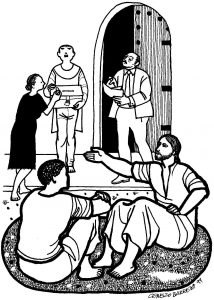
At this morning’s eucharist, after the St Margaret’s congregation had sung the hymn “All for Jesus”, Michael Paterson shared the uncomfortable reading of today’s Gospel from three different perspectives – as a priest; as a politician at COP26; as church folk – before offering an alternative ‘good news of our Lord according to the poor of our world’.
He continued: “Friends, it’s easy to hear today’s Gospel and thank God that we are not scribes and Pharisees. It’s easy to hear today’s gospel and point the finger at world leaders who are not a bit like us. But it takes real honesty and courage to face the challenge that this Gospel might just be about you and about me.
“Speaking personally, I would rather someone else was preaching today and I was sitting where you are. Because underlying today’s gospel are two piercing questions which challenge me to the core. The first is this: Am I a part-time or a full-time Christian? And the second is: Am I a person of religious words, or am I a person of Christian action?
“And what about you? Are you a part-time or a full-time Christian? And are you a person of religious words, or a person of Christian action?
“‘All for Jesus, all for Jesus’ – not what’s left when I get round to it, not the scraps of my energy or free time, not the loose change that I won’t miss, but my own widow’s mite. ‘ALL for Jesus. ALL for Jesus.’
“Let’s stand and sing the hymn together and make it an act of commitment and renewal.”
We did that, and then joined in the Creed for the Planet that you’ll find at this link.
Do read the whole of Michael’s sermon at this link.