A Thought to Share
Until December 2022 called “Thought for the Month”

At our Communion Service on Sunday 12 October 2025, Rev’d Daniel George reflected on the story of Naaman in 2 Kings 5:1–15. He started:
“This story is not only about physical healing but about the healing of the soul, about the change that takes place when a heart begins to realise that its hatred and violence, its pride and arrogance, are a sickness. …
“Into this world of violence comes a young Israelite girl, taken captive in war, serving in Naaman’s house. She is Jewish and female, looked down upon by her captors. She has every reason to feel resentment, every right to remain silent. Yet she speaks compassion: ‘If only my lord were with the prophet in Samaria; he would cure him of his leprosy.’
“Her whisper pierces the veil of scorn. Though oppressed, she becomes the educator; she has not been corrupted by her oppressors, and she has remained true to her God. Her small act of faith begins the long road to Naaman’s redemption.”
Later Daniel commented: “Naaman’s story reminds us that the voice of God is often carried by those without power or status, and that peace begins when pride gives way to humility, when hatred gives way to love, and when hearts are open to hear truth.
“This story speaks to our own time. The same sickness that afflicted Naaman, his pride, his anger, his learned hatred, still corrodes our world today. We see it in the violence between nations, in antisemitism, in prejudice, in the persecution of women across the world and the silencing of the powerless. These are the modern forms of leprosy that mark our collective human soul. Healing begins when hatred ends and when we listen again to the quiet truth of compassion. Faith is born when we allow the healing voice to speak and to break the cycles of vengeance and hatred.”
And he ended: So, like the Jewish servant girl, let us speak mercy into hatred, trusting that every small step toward peace builds God’s kingdom. From Naaman’s healing to Christ’s cross, the Bible’s call is clear: God’s mercy knows no borders, and we are all called to work towards peace.
To see how Naaman’s story plays out, and how it relates to our search for peace, you’ll have to read the whole of Daniel’s reflection at this link.
The whole service had a focus on peace, the Sunday marking the start of the Week of Prayer for World Peace.
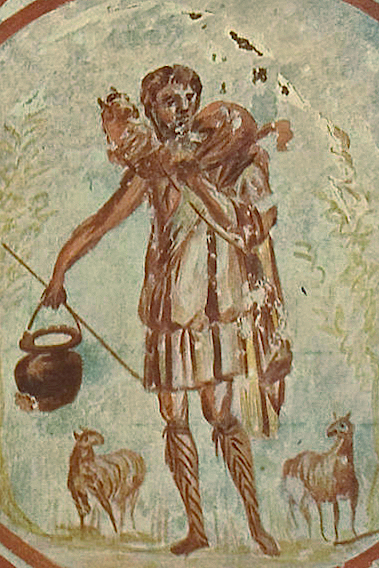
“The Lord is my Shepherd; I shall not want.”
“We know the words of Psalm 23 so well, yet they remain as fresh and challenging as when they were first sung millennia ago. Alongside Jesus’ parable of the lost sheep (Luke 15), we are given a glimpse into the heart of God: a Shepherd who refuses to lose even one of His flock.
“The shepherd in the parable does not shrug and settle for ninety-nine out of a hundred; he searches until the one is found. The woman (in the second part of the teaching) does not accept nine coins as ‘good enough’; she turns the house upside down until the last is restored. And when the lost is found, joy erupts, on earth and in heaven alike. These images invite us to trust. To say with conviction, even in the darkest valley:
“The Lord is my Shepherd, I shall not want … Yea, though I walk through the valley of the shadow of death, I will fear no evil.”
“This is a declaration of truth. The sheep’s safety does not rest on the sheep’s hard work or cleverness. It is not about mustering enough wisdom or grit, reading enough books, or being more virtuous than the next. It is about daring to entrust ourselves to the One who has assumed responsibility for us.”
That is how Rev’d Daniel George started his sermon during our service on 14 September 2025. A big thank you to Daniel for reworking what he said into the reflection that you can read in full at this link. And do think about the “Points for reflection” on the final page.
The image is one of the oldest representations of Jesus as the Good Shepherd, found in the Crypt of Lucina, part of the Catacomb of Callixtus, and shows Christ as the Good Shepherd who carries and cares for his flock. Attribution: unknown artist, Rome, 3rd century AD, Public domain, via Wikimedia Commons

Luke 10:38–42 tells the well-known story of a village household where Martha is busy serving, preparing food, hosting guests, while her sister Mary sits at Jesus’ feet, simply listening. Eventually, Martha becomes frustrated and asks Jesus to intervene, but doesn’t get the answer she’s expecting. This post contains some extracts from Dr Keith Burns’ reflection at our service of Morning Worship on 20 July 2025.
In today’s world, many of us are deeply familiar with Martha’s experience. We strive to be dependable, capable, and efficient. We try to keep everyone happy, to meet expectations, and to hold everything together — often feeling that if we don’t do it, no one will. In this kind of world, our value is often measured by our output, and busyness is worn like a badge of honour. But Jesus offers us another way: the way of presence, peace, and rest in Him.
This doesn’t mean abandoning our responsibilities. Jesus never says that Martha’s work is unimportant. What He offers is a reordering of our hearts — a call to come to Him first, to centre our lives in His presence, so that everything else flows from that place of stillness and love. When we take time to be with Him, even briefly, we find that our work becomes lighter and our relationships richer.
…
Jesus’ gentle words to Martha are not only meant for her; they are for us too: “You are worried and distracted by many things; there is need of only one.” He is not scolding her — or us. He is inviting us to return. To let go of the pressure and the noise, and to come back to the one thing that matters most.
As Paul says, “Christ in you, the hope of glory” (Colossians 1:27). This is not a God who is far away, but One who dwells within us, who strengthens us, and who gives us peace in the middle of whatever we’re facing.
What would it look like this week to carry that awareness with us? To begin each day with a short prayer: “Jesus, help me to stay close to You today.” To pause in the middle of a busy afternoon and remember: “You are with me. I don’t need to do this alone.”
May we be people who serve with Martha’s hands but keep Mary’s heart. May we find moments to pause, to sit, and to listen. And may we discover, again and again, that Christ is the one who holds everything together — including us.
You can read the whole of Keith’s sermon at this link.
Our picture of Christ in the House of Martha and Mary was painted in 1628 by Jan Brueghel the Younger and Peter Paul Rubens, an example of artistic collaboration between two of the Flemish Baroque era’s most celebrated painters. The image is in the public domain, via Wikimedia Commons. You may enjoy the reflection on the painting at this link.

Easter energises us spiritually. The stone was not rolled away to let Jesus out. His resurrected body didn’t need that, as his later appearances were to demonstrate. No, it was rolled away to let us in; to show us, as it showed the disciples, that the resurrection is not wishful thinking. It is a reality, then, now and always. Jesus did not come back to life; he was not a survivor. No, the resurrection is so much more than that. Jesus moved through death and defeated it, once for all, so that we need have no fear of it.
The resurrection is not just an interesting incident to read about; it is a reality; it is a life-changer; it is the fulfilment of all Jesus spoke about during his ministry; everything Isaiah and the prophets envisioned. When God’s love and man’s sin battled at the cross, God’s love won and continues to win in the risen Christ.
So, brothers and sisters in Christ, welcome to our gathering of the forgetful and the doubtful, the far from perfect community of disciples that is united with the women and all followers of Jesus in his life, death, and resurrection. His resurrection has happened to us and God is at work in each of us now, working to accomplish salvation. Jesus’ resurrection from the dead in that garden has begun God’s new creation.
Alleluia! The Lord is risen! He is risen indeed. Alleluia!
This post is the final section of the sermon preached by the Rev Carol Latimer at St Serf’s, Burntisland on Easter Day, 20 April 2025. You can read the whole sermon at this link.
The post title, chosen by your webmaster, also reflects a line in the hymn we sang on Good Friday – “There is a green hill”.
Photo by Pisit Heng on Unsplash.

At Morning Worship last Sunday (2 March) we celebrated our 109th Church Anniversary with the help of our friend Professor John Sawkins. John had chosen hymns broadly on the theme of our journey as Christians, four of which had associations with previous significant moments in the church’s story. His all-age address was on “Baggage”, with a packed suitcase illustrating both essentials and unnecessary extras best left behind, and his sermon continued the theme: “What are the essential pieces of baggage that we, as people who follow Christ, need?”
In bringing to life his text from 2 Corinthians 5:19 – “God was in Christ reconciling the world to himself” – John offered two answers to the question he had posed (the Bible, and faith in Jesus Christ) and concluded his sermon with these challenging words:
“Throughout its history, this church congregation, wherever it has met, had offered not just rooms to let and a place to meet.
“This church congregation has offered good news that opens up the possibility of new beginnings for everyone, whoever they are, whatever their circumstances are, whatever age or stage of life they are at.
“So as you, as we, step into a new year as a church congregation, let us resolve to live out in mission and service the good news of Jesus Christ,
– in the way in which we welcome people,
– the way in which we treat people,
– the way in which we respect people,
– the way in which we build people up,
– the way in which we forgive people,
– and perhaps most of all, the ways in which we tell people that “God was in Christ reconciling the world to himself.”
“Thanks be to God for his great love in Christ. Amen.”
You’ll want to read the whole sermon, which you’ll find at this link,
Photo by Mantas Hesthaven on Unsplash